Copy library / Comparisons / Multiple
Choosing between Muse and Grok Bot by how work is organized, not feature lists
# Muse 和 Grok Bot 怎么选:看任务组织方式而非功能清单

Source: https://x.com/Bagel8343/status/2115293237707477291

Author: Bagel8343

作者依据截至 2026 年 10 月 28 日的官方资料给出试用顺序:生活事务和个人目标管理先试 Meta Muse;有明确职责、重复交付和跨工具协作的工作先评估 Grok Bot。建议用约 10 个真实任务对比可接受交付、人工复核时间、严重错误、恢复结果和总成本,并说明这不是实测胜负。
- What it does
- Based on official material as of 2026-10-28, the author suggests a trial order: start with Meta Muse for personal preferences and life admin, and evaluate Grok Bot first for recurring research, file delivery and explicit responsibilities. Run about ten real tasks and track acceptable deliverables, review minutes, serious errors, recovery and total cost. He stresses it is not a tested ranking.
- Scenarios
- Research & monitoring
- What the source covers
- Author & original linkYes
- What it doesYes
- Verbatim source excerptYes
- Screenshots / mediaYes
- Steps / chaptersNot in source
- Verbatim prompt / configNot in source
- Results / numbersYes
- Risk notesYes
- Related entriesYes
— means the source doesn't say; we don't fill it in.
- In the author's words
How to choose between Muse and Grok Bot
The least useful agent comparison copies two feature lists and declares a winner. In practice, a disconnected tool, an unusable deliverable, or an unexpected action can matter more than the length of either list.
My recommendation is a testing order: start with Meta Muse for personal administration and goals; evaluate Grok Bot first for named responsibilities, recurring deliverables, and work across tools. Their capabilities overlap. This is a reading of official materials checked on October 28, 2026, not a head-to-head performance result.Show full post
Start with how the work is organized
Meta introduced Muse on September 8 and announced its Japan launch on October 23. These are existing developments, not news breaking today. Its positioning centers on a person’s goals, schedule, and everyday administration. [1] [2]
Grok Bot emphasizes named Bots with defined jobs and durable working context. Its skills describe how work is done; routines determine when it runs. [3] [4] That makes it worth testing first when you want an ongoing industry researcher and a separate editorial responsibility.
This is a preference, not a capability wall. Muse’s design article also describes a terminal, document and webpage creation, and continuing background work. [5] It is not limited to personal errands. Compare how much explanation and correction each product needs for your recurring tasks.
Check eligibility before designing the workflow. A regional Muse announcement does not establish worldwide access. Grok Bot’s current documentation lists compatible Cursor and SuperGrok subscriptions, among others; an X badge alone is not sufficient evidence of access. [2] [3] Verify the actual plan, limits, and connections available to your account.
The overlooked distinction is the permission boundary
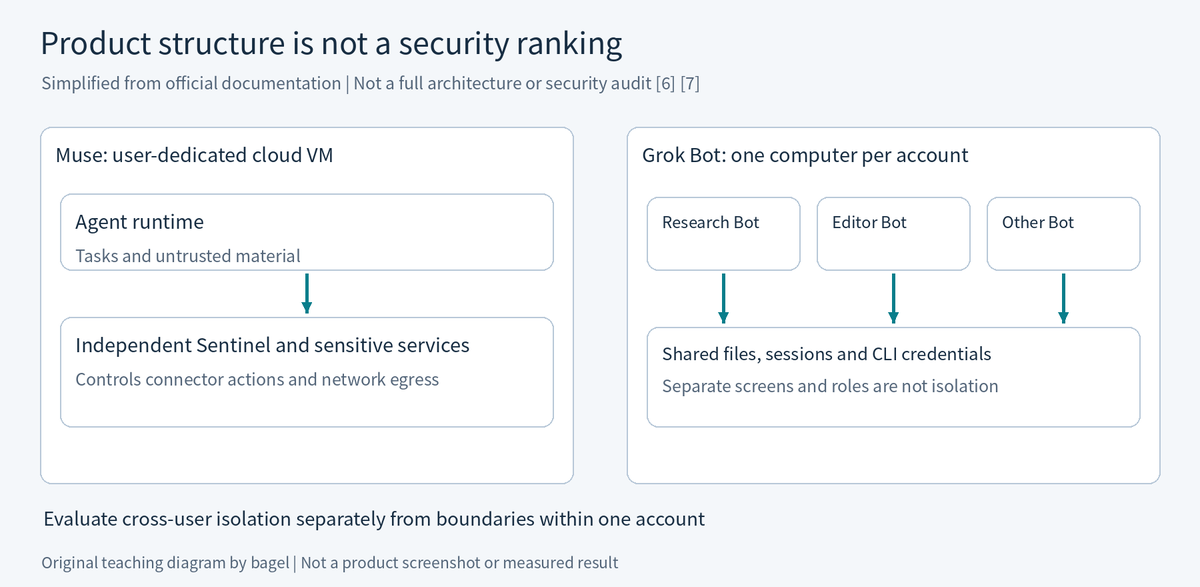
Grok Bot’s detailed documentation says that Bots on the same account share a cloud computer, including files, browser sessions, and command-line credentials. Separate screens are not separate security boundaries. [6] Naming three Bots Researcher, Finance Assistant, and Personal Assistant does not automatically isolate their data.
Sharing makes handoffs easier: another Bot can continue saved work. It also changes what belongs in that environment. If clients or data classifications require strict separation, role descriptions are insufficient. Verify the product’s account or organizational isolation options; do not connect the data if those controls fail your requirements.
Muse’s security article describes separating the agent runtime from sensitive services, with an independent Sentinel controlling connector actions and network egress. [7] That is a vendor-disclosed architecture, not my security audit or proof of zero risk. Neither product’s documentation establishes that the other is necessarily unsafe.
Test a complete workflow
Consider a weekly technology brief. My proposed workflow is to collect specified sources with event dates, shortlist three candidates, prepare bilingual copy and illustrations, verify facts and calculations, and check that delivered files open. Stop at a reviewable draft. Missing sources should produce a gap report, not recycled figures presented as current.
In Grok Bot, start with one Bot completing the whole task before splitting research and editing. Its documentation recommends validating a one-time task before saving a skill and scheduling a routine. [4] Adding Bots too early may add handoff and debugging costs. Apply identical acceptance criteria to Muse; a terminal and file-generation capability do not establish delivery quality.
Define authorization separately for sending, purchasing, and publishing. Grok Bot documents approvals and Auto Review rules: Ask first takes precedence when it also matches an Allow automatically rule. Muse describes confirmation for consequential actions too. [1] [8] The account, recipient, and exact version must be identifiable. Website operation does not establish permission for every platform automation. Validate drafting and publishing separately.
The revealing cases are an expired login, an inaccessible source, or a damaged attachment. Does it stop and explain, or claim completion? Can it resume from a checkpoint without repeating an external action? Include those cases rather than judging only a smooth demonstration.
Price your review time as well as the subscription
Take a hypothetical example unrelated to either product’s actual plans. Suppose one option costs an extra $20 per month but saves two human minutes per accepted task. At $30 per hour, that releases $1 of time value per task. Twenty tasks cover the extra fee; 10 release $10 and 50 release $50.
The break-even assumes no additional setup or recovery cost. Extra costs raise the required volume. Released time is not necessarily cash savings: it matters only if time is actually freed and the opportunity-cost assumption is meaningful. Free entry does not mean zero total cost, and a higher fee does not establish better capability.
I would test the same 10 tasks on both products, repeating each batch twice: five sourced research summaries, three content deliverables, and two spreadsheet outputs. Keep sources, acceptance criteria, and budgets equal. Add expired-login and missing-source tests. If a product cannot deliver an item, record that instead of quietly substituting an easier task.
Track acceptable deliverables, human review minutes per task, serious errors, recovery outcomes, and total costs. Include failed attempts and rework. Ten tasks are a starting point, not proof of general reliability. The goal is to choose for your work, not crown a universal winner.
My decision
For personal preferences and life administration, I would start with Muse. For recurring research, file delivery, and explicit responsibilities, I would evaluate Grok Bot first. That preference follows their product organization, not a ranking of model intelligence.
If the necessary connection, regional access, subscription, or data separation is missing, postpone the migration. Watch recovery, visible permissions, accepted-delivery rate, and review effort—not only new model names. Keep the product that reduces repeated explanation and rework on your tasks.
Primary sources
[1] Meta Introducing Muse https://t.co/otn9A3xQtI
[2] Meta Japan Muse launches in Japan https://t.co/xawKFU9XXJ
[3] Grok Bot Docs Overview https://t.co/6omTXiaBuu
[4] Grok Bot Docs Skills and routines https://t.co/tBTQE5Q2tv
[5] Muse How We Designed Muse https://t.co/jM044YbDVg
[6] Grok Bot Docs Use the computer and apps https://t.co/aZysmtA4yI
[7] Meta AI Research How We Built Safety Into Muse https://t.co/ymGiqmS90z
[8] Grok Bot Docs Approvals security and privacy https://t.co/k6f6Nw9yeA@Bagel8343 · · Open on X ↗ The author's post, quoted verbatim and left untranslated.
- Screenshots

Screenshot from the original post - Prompt
The source does not include a prompt you can copy verbatim.
- How to copy
- Read the source: x.com ↗
- Turn the steps/prompts from the source into one message for your Bot
- Run it manually once, then decide the frequency
- Risks and limits
- Involves payments, orders or bookings: let the bot draft first and act only after you confirm
- Uses a browser or website login: the costliest kind of step, so prefer a connector where one exists
- Scheduled runs keep consuming usage: start at a low frequency and raise it once it is stable
- The author's result may not reproduce for you; the original post is the reference
- Usage estimate
- Estimate with the metal calculator